Opening the Power of Bar Model Illustration Techniques for Effective Trouble Addressing in Math
Bar design drawing methods provide a distinct visual technique to maths that can improve problem-solving capacities. By simplifying complex connections and making abstract principles much more accessible, these designs serve as powerful tools for students. The effectiveness of bar versions relies heavily on correct implementation. Understanding the vital concepts behind their use can bring about substantial renovations in mathematical understanding and communication. The concern continues to be: how can educators best incorporate these methods into their teaching strategies?
Understanding Bar Designs: An Aesthetic Technique to Math
Although maths can usually appear abstract and challenging, bar designs offer a visual method that streamlines analytic and boosts understanding. These versions use rectangular bars to stand for relationships and numbers, making mathematical principles much more concrete. By aesthetically segmenting amounts, bar versions permit students to much better comprehend procedures such as enhancement, reduction, department, and reproduction.
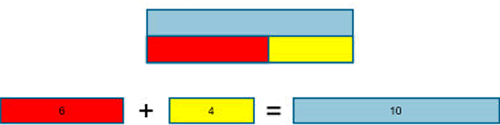
When faced with word problems, pupils can attract bars to represent different aspects, helping in the visualization of relationships between numbers. This strategy not only aids in arranging information however additionally motivates abstract thought. For instance, in a trouble entailing total quantities, bar designs can define parts and wholes, making clear the called for computations. As trainees practice with bar designs, they create self-confidence in their mathematical capabilities, enabling them to approach complex issues with a structured way of thinking - bar model drawing techniques. Bar models offer as a crucial device in the learner's mathematical toolkit.
The Advantages of Utilizing Bar Versions in Trouble Addressing
Bar versions offer numerous advantages when it involves trouble fixing in maths. They give an aesthetic depiction of numerical connections, permitting trainees to conceive troubles extra effectively. By converting words right into bars, learners can break down intricate scenarios into workable parts, therefore helping with a more clear understanding of the trouble at hand.
Furthermore, bar models promote vital thinking and logical abilities as pupils find out to manipulate benches to find solutions. This visual aid helps in identifying patterns and connections amongst numbers, making abstract concepts much more tangible. Bar designs boost communication in mathematics, enabling pupils to express their believed options and processes clearly.
How to Create Effective Bar Models
Developing efficient bar models calls for a methodical method that emphasizes clarity and accuracy. The very first step entails identifying the problem's crucial elements, consisting of partnerships and amounts. Next off, one need to select ideal systems for representation, making certain proportionality amongst benches. This help in picturing the connections a lot more properly.
After identifying the amounts, the version needs to be attracted, plainly labeling each bar to show its corresponding worth. Utilizing various colors can improve understanding by comparing numerous components in the issue. It is additionally important to preserve consistent spacing between bars, which aids stop complication.
As soon as the version is constructed, validating its accuracy with estimations reinforces its efficiency. Exercising with a range of trouble types will boost effectiveness in creating bar designs. Inevitably, a well-designed bar design not just simplifies complicated troubles but also promotes much deeper understanding and problem-solving skills in maths.
Bar Versions at work: Real-Life Examples
When related to real-life circumstances, bar versions can properly illustrate complex connections and amounts, making them indispensable devices in numerous contexts. In budgeting, individuals can utilize bar models to visually contrast income and expenditures, helping in identifying surplus or deficiency. In a grocery purchasing scenario, a bar model can represent the cost of various products, enabling consumers to quickly analyze complete spending and make notified choices.
In sports, trains might employ bar designs to analyze player statistics, such as factors scored over a period, aiding to determine efficiency patterns. Additionally, in project administration, bar models can highlight job periods and resource allowances, promoting more clear communication amongst employee. These examples demonstrate just how bar designs go beyond scholastic limits, giving quality in daily decision-making and boosting understanding of measurable relationships in various fields.
Integrating Bar Models Into Class Knowing
Incorporating bar designs into class knowing can greatly boost trainees' ability to envision mathematical ideas. This approach not just aids specific understanding however additionally promotes collective knowing amongst peers. By interacting to resolve problems utilizing bar models, trainees can create deeper understandings and strengthen their mathematical abilities.
Imagining Mathematical Principles
Bar models work as an effective tool for envisioning mathematical ideas in the class. By representing numbers and connections through bars, trainees obtain a clearer understanding of abstract ideas such as addition, division, reproduction, and subtraction. This aesthetic help streamlines intricate issues, enabling learners to damage them right into manageable components. Teachers can properly show relationships between quantities, making it less complicated for pupils to grasp ideas like proportion, percentage, and portions. Bar versions also motivate independent analytical, as pupils can adjust the aesthetic depiction to locate solutions. Integrating these designs into lessons not only improves trainee involvement however also sustains diverse discovering designs, making certain that all pupils can access and understand mathematical web content better.
Motivating Collaborative Discovering
Collective discovering can be markedly enhanced via using bar versions in the class. By integrating these visual tools, educators can cultivate a setting where pupils participate in group problem-solving, leveraging each other's strengths. Bar versions promote conversations, making it possible for students to verbalize their thought processes and thinking plainly. This visual representation encourages diverse approaches to take on mathematical troubles, advertising much deeper understanding. Pupils can compare their models, identify disparities, and collaboratively fine-tune their services (bar model drawing techniques). Additionally, interacting with bar designs cultivates vital skills such as communication, essential reasoning, and team effort. Generally, integrating bar versions right into collaborative learning not just strengthens mathematical understanding yet likewise develops a helpful class culture where students gain from each other
Usual Errors to Stay Clear Of When Using Bar Designs
They usually come across details risks that can prevent their understanding of mathematical concepts when students engage with bar models. One common mistake is misstating the amounts entailed. Pupils might attract bars of unequal sizes to stand for equal worths, resulting in confusion. Additionally, failing to label benches plainly can lead to uncertainty regarding what each bar represents. One more frequent error is overlooking the importance of scaling; pupils might neglect to keep symmetry, impacting the interpretation of relationships in between numbers.
Some learners may rush with the analytical procedure, overlooking to examine the read more trouble before attracting the model. This can result in incorrectly structured bars that do not correspond to the trouble's demands. Finally, pupils often focus solely on finishing the design without showing on the service, missing the opportunity to deepen their understanding of the underlying mathematical concepts. Awareness of these mistakes can significantly boost the efficiency of bar design techniques.
Urging Vital Thinking Through Bar Model Techniques
Furthermore, bar designs advertise discussion and partnership among peers, as students share their interpretations and solutions. This exchange of ideas grows an important state of mind, permitting students to examine numerous approaches to an issue. Inevitably, including bar model methods in maths education and learning not only enhances analytical capabilities yet additionally nurtures the important reasoning skills needed for scholastic success and real-world applications.
Regularly Asked Inquiries
Can Bar Models Be Used for Advanced Mathematical Concepts?
Bar designs can without a doubt be utilized for sophisticated mathematical principles. They provide graph and simplify intricate problems, assisting in recognizing procedures and partnerships. This strategy boosts analytic abilities throughout different degrees of mathematical proficiency.
What Age Group Advantages Many From Bar Model Techniques?
Children aged 7 to 12 advantage most from bar version methods. This age group usually struggles with abstract principles, and bar versions supply aesthetic support, enhancing their understanding and problem-solving capacities in maths.
Exist Digital Equipment for Creating Bar Designs?
Yes, there are a number of electronic devices offered for developing bar versions, consisting of software application like Google Drawings, Microsoft PowerPoint, and specialized instructional applications made for imagining mathematical ideas through bar modeling strategies properly.
How Do Bar Versions Contrast to Various Other Visual Aids?
Bar models supply a clear, organized depiction of mathematical partnerships, often providing advantages over various other visual help by simplifying intricate issues (bar model drawing techniques). Unlike pie charts or charts, they boost comprehending through straight comparison and symmetrical representation
Can Disallow Designs Assist With Non-Mathematical Problem Solving?
Bar versions can help with non-mathematical issue resolving by visually representing relationships and components, simplifying intricate circumstances. Their organized technique assists individuals analyze troubles clearly, cultivating better decision-making and tactical reasoning in numerous contexts.
As pupils method with bar designs, they develop self-confidence in their mathematical capacities, permitting them to approach intricate issues with a structured frame of mind. Additionally, bar designs advertise important reasoning and analytical skills as students discover to control the bars to find services. In addition, failing to label the bars clearly can result in uncertainty regarding what each bar indicates. Bar models provide a clear, structured representation of mathematical connections, usually offering advantages over other visual aids by simplifying complex problems. Bar models can assist with non-mathematical problem resolving by visually representing components and relationships, simplifying complex situations.